


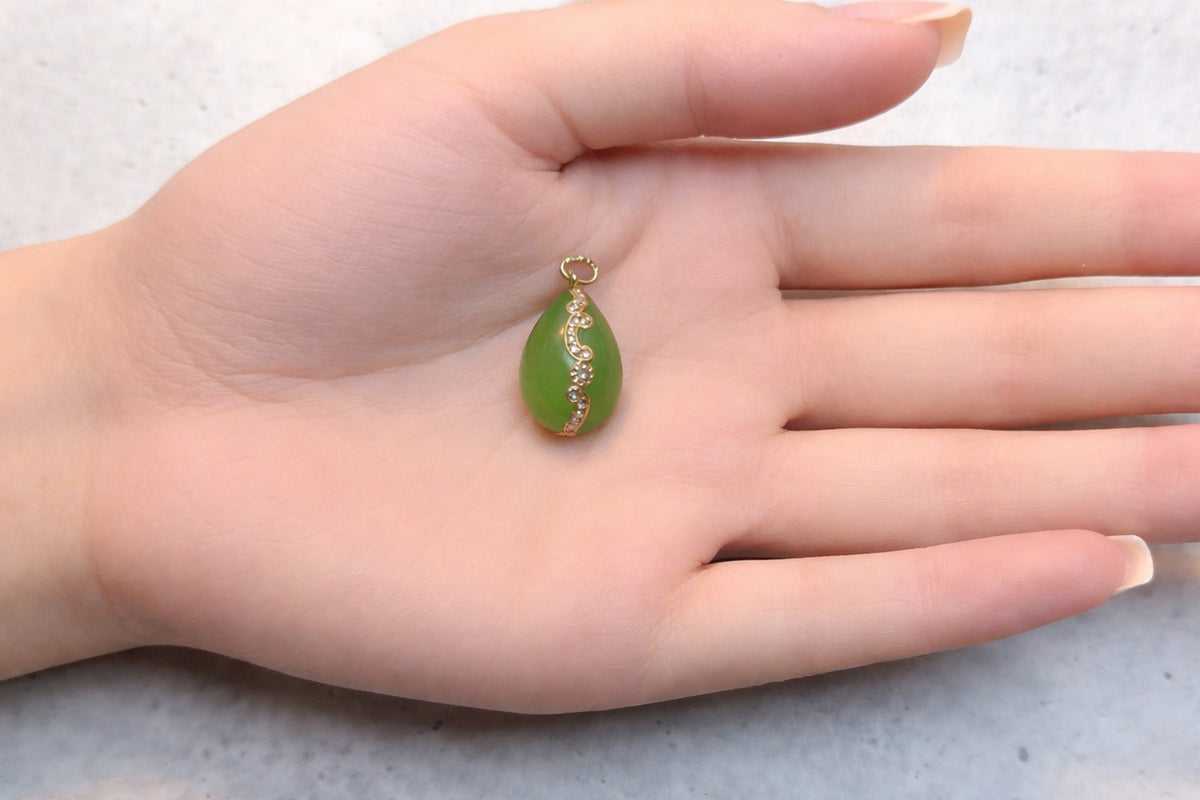


We are pleased to present an exceptional and rare miniature egg pendant from the Russian Imperial era. Crafted in the St. Petersburg workshop of the famous master jeweler Karl Gustav Hjalmar Armfeldt for the House of Fabergé in the late 19th century and early 20th century, this piece is a superb example of Fabergé's artistry in hard stones.
The pendant is meticulously carved from Russian jade and mounted in gold and adorned with a gold ornament set with a scattering of very small, old-cut diamonds. Its elegant proportions measure 19 mm in length (including small bales) and 12 mm in width, with a weight of 3.7 grams.
It remains in excellent original condition.
The pendant bears several important original marks, confirming its provenance and authenticity:
The workmaster's Cyrillic initials "ЯА" (YA) are the master's mark of Karl Gustav Hjalmar Armfeldt (Ялмар Армфельт).
The Imperial Russian gold standard mark "56" (equivalent to 14 karats or 585 fineness).
Cyrillic initials 'АР' (AR) - assay master of the St. Petersburg Assay Office, Alexander Vasilyevich Romanov (Александр Васильевич Романов).
About the Master: Karl Gustav Hjalmar Armfeldt was a Finnish silversmith and Fabergé workmaster. He worked as Fabergé's workmaster beginning in 1895, and used the mark ЯА. Armfeldt also worked under the silversmith Antti (Anders) Nevalainen and became his closest assistant in 1901.
He became a master in 1904 and was given the exclusive opportunity to buy the workshop of Johan Victor Aarne. Armfeldt produced objects for Fabergé until 1916, working on projects like those of Johan Viktor Aarne, like tiny gem-set frames, silver-mounted birchwood frames, hardstone frames, gem-set enameled gold articles, and silver figures on hardstone bases.
This pendant is a historically significant treasure, offering a tangible connection to the opulence of Imperial Russia. It represents a premier acquisition for the discerning collector of Fabergé, Russian works of art, or exceptional antique jewelry.
Please note: Works attributed to Karl Fabergé, the Fabergé workshops and their associated workmasters, as well as other objects produced during the Imperial Russian period of the late 19th and early 20th centuries, were not originally accompanied by certificates of authenticity at the time of manufacture.
Attribution and opinions regarding authenticity are based on examination of original maker’s and assay marks, analysis of materials and workmanship, assessment of construction techniques, and comparison with documented examples published in recognized scholarly literature and archival sources. Such evaluations represent informed expert opinion in accordance with accepted practices within the field of Russian Imperial decorative arts.