


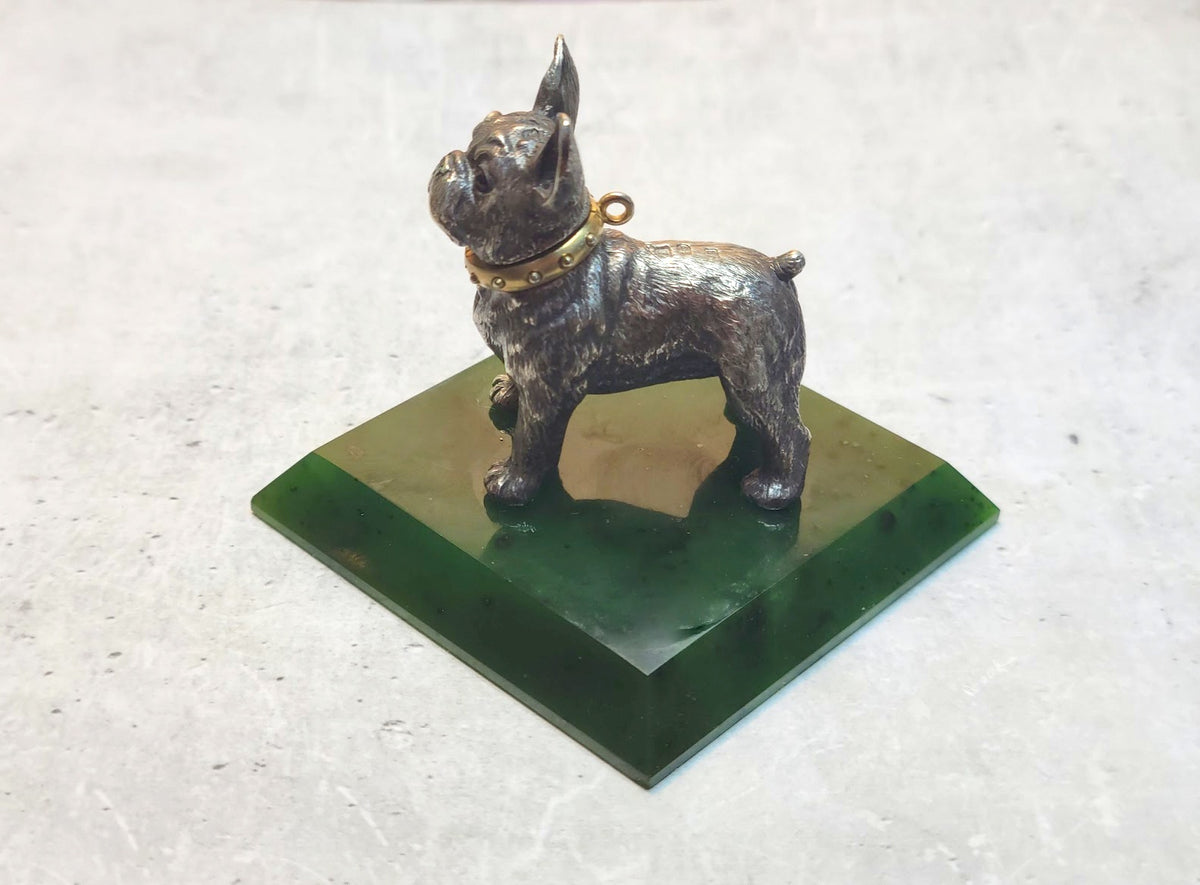


Allow us to present yet another treasure from our collection—an antique figurine from the era of the Russian Empire, crafted in the workshop of the illustrious Carl Fabergé. This exquisite miniature depicts a silver French bulldog with ruby eyes and a golden collar, elegantly poised on a jade stand. The masterpiece was created by the celebrated jeweler Julius Rappoport.
An interesting fact: among the personal belongings of Dowager Empress Maria Feodorovna, which were transported to Moscow by the Provisional Government, there were about a hundred figurines by her beloved Fabergé. A special place in her collection was occupied by elephants—the heraldic symbol of her native Denmark—and dogs (bulldogs and pugs). Perhaps this was due to the fact that her husband, Emperor Alexander III, was affectionately called "bulldog" within his family during childhood. 😊
Julius Rappoport was the leading master of the Fabergé firm, specializing in the creation of magnificent silver animal figurines. His early works date back to around 1890. Having begun his career in Germany, he was influenced by the traditions and artistic inspiration of outstanding masters such as Wenzel Jamnitzer. This allowed him to achieve an extraordinary level of realism in depicting animals.
Rappoport's figurines are distinguished by their exquisite detail, and each feature is rendered with masterful accuracy. While silver animal models existed before Fabergé, Rappoport's works became a symbol of refined realism and unparalleled quality.
The figurine bears original hallmarks:
"88" — the Imperial silver standard.
Cyrillic initials "КФ" - Carl Faberge (Карл Фаберже).
The master's mark: "I.P." followed by a dot — the initials of Julius Alexandrovich Rappoport (Isaac Abramovich Rappoport, 1851–1917).
Square nephrite stand dimensions: 55 mm.
Figurine dimensions: Length: 32 mm. Height: 40 mm.
Total weight: 138.5 g.
Bulldog’s eyes: Natural ruby cabochons.
Collar: 56 (14K) gold.
Stand: Genuine Siberian nephrite (Russian origin).
An exceptional item!
Own a piece of history – breathtaking, rare, and utterly enchanting!
Please note: Authentic Fabergé objects from the late 19th and early 20th centuries were not issued with certificates of authenticity.
Authenticity is determined through examination of original maker’s marks and assay marks, materials, craftsmanship, construction techniques, and comparison with published reference examples.